The idea of an AI system acting as a virtual executive team sounds ambitious. In practice, however, the value of such a system is not determined by how convincingly it imitates a human CEO. It is determined by whether it helps a business make better decisions, maintain continuity and execute important work more consistently.
This is where OpenExecutive becomes interesting.
OpenExecutive is an open-source AI system designed to organize business work around a central company context and a set of specialized executive functions. Instead of treating every interaction as an isolated prompt, it connects business information, tasks, analysis, memory and communication through a coordinated operating layer.
That distinction matters particularly for small businesses.
A small business owner may be responsible for strategy, marketing, customer communication, administration, research, technical operations and financial decisions at the same time. The problem is often not a lack of information. The problem is that information arrives from too many places, priorities compete with one another and important tasks are easily interrupted by new requests.
OpenExecutive does not eliminate these problems automatically. It does, however, provide a framework for addressing them.
Based on practical use with a small-business setup, OpenExecutive is best understood as an AI operating layer rather than an autonomous CEO. Its strongest potential lies in connecting business context, current data, specialized analysis and ongoing execution.
What Is OpenExecutive?
OpenExecutive is an open-source, AI-powered virtual executive team. Its architecture is built around a central orchestration layer and specialized roles or departments covering areas such as:
- Strategy
- Finance
- Operations
- Marketing
- Product
- People and HR
- Legal
- Board or executive communication
The system can use a shared company context and a knowledge base to make its responses more relevant to the business it supports. It also includes memory, scheduled tasks and integrations that allow it to work with external information and communication channels.
The important concept is not simply that several AI agents exist. Multi-agent systems are becoming increasingly common. The more relevant question is whether those agents are organized around a coherent business context and whether their work contributes to common objectives.
OpenExecutive attempts to address that problem by providing a central operating environment rather than a collection of disconnected AI conversations.
Why an AI Operating Layer Matters
A conventional chatbot generally works like this: the user asks a question, the model generates an answer, and the conversation ends or waits for the next prompt.
This can be useful, but it places much of the organizational responsibility on the user. The user must remember previous decisions, provide context repeatedly, track unfinished tasks and decide which specialist should handle each problem.
An operating layer changes the structure. Instead of asking isolated questions, the business can provide company information, current projects, strategic goals, target markets, customers, key performance indicators, department responsibilities, existing tasks, relevant documents, and operating rules and constraints — a shared foundation the AI system can use for analysis and coordination.
The main advantage is not necessarily that one model produces better answers than another. The advantage is that the work is organized around the business rather than around individual prompts. This is particularly valuable when the same questions return in different forms: what should receive attention this week, which project is falling behind, which customer request is urgent, which SEO opportunity is commercially relevant, what was decided previously, what still needs to be completed.
Without continuity, these questions require repeated manual reconstruction. With a sufficiently well-maintained operating context, the system can begin to treat them as parts of one ongoing business process.
KLYRA's Practical Setup
The most useful way to evaluate OpenExecutive is not through its feature list alone, but through an actual working setup. For KLYRA, OpenExecutive is currently used with:
- GLM-5.3-Flash as the primary language model
- The OpenExecutive web interface
- Telegram for communication and email integration
- DataForSEO and other SEO tools, plus RSS feeds and web sources
- A virtual Linux machine on a small desktop with an Intel i5 processor and 16 GB of RAM
This is not a large dedicated AI server. It is a relatively modest environment designed to test whether a coordinated AI operating layer can deliver practical value without requiring substantial infrastructure.
The system is used throughout the day in shorter review cycles. Approximately one hour per day is spent reviewing recommendations, answering questions, making decisions and adjusting workflows.
That distinction is important. OpenExecutive is not being treated as a system that should independently run an entire company without supervision. It is being used as a continuously available operational partner that prepares information, identifies priorities and supports execution.
What OpenExecutive Is Already Doing
Email control and processing
One of the most immediately useful functions is email handling. Instead of manually reviewing every incoming message, OpenExecutive can help filter and classify email, identify messages that require attention and distinguish important developments from routine communication.
The goal is not to automate every response indiscriminately. The goal is to reduce the amount of attention required for low-value communication while ensuring that important messages are not overlooked — identifying messages that need a decision, highlighting urgent or commercially relevant requests, separating routine notifications from meaningful communication, preparing responses, summarizing ongoing conversations, maintaining follow-up tasks and escalating unusual or sensitive cases.
This changes the role of the inbox. Instead of being a constantly interrupting task list, it becomes one of several information sources monitored by the operating layer. The user can focus on messages that actually require judgment rather than spending the same amount of time processing every incoming item.
Data analysis
OpenExecutive is also useful for analyzing data from multiple sources — particularly relevant when the business has several projects, each with different goals, metrics and data sources. A conventional dashboard may show the data, but it does not necessarily explain what the data means for the business as a whole.
An AI operating layer can connect the information to existing priorities: comparing performance across projects, identifying changes in search visibility, reviewing SEO opportunities, evaluating competitors, detecting potential risks, connecting new information to current goals, and recommending which issue deserves attention first.
The important point is that the analysis is not performed in isolation. It is interpreted in the context of the company's projects, resources and objectives — which is where a shared knowledge base becomes essential.
Strategic planning
OpenExecutive can support strategic planning by organizing information and turning it into structured recommendations: reviewing current objectives, identifying conflicts between priorities, comparing opportunities, suggesting next steps, evaluating risks, preparing decision options and coordinating follow-up work.
The system does not replace business judgment. It helps make that judgment more informed and more consistent. For a small business owner, this can be valuable because strategic thinking is often interrupted by operational details. A system that continuously maintains the connection between daily tasks and larger goals can help prevent short-term requests from completely displacing long-term priorities.
Maintaining focus and continuity
One of the strongest practical benefits is continuity. Small businesses often generate more ideas and opportunities than they can execute. A new idea may be important, but it can also distract from tasks that were already agreed upon.
OpenExecutive can help maintain a connection between existing commitments, new requests, strategic priorities, unfinished tasks, deadlines and recommended next actions. This means new ideas do not necessarily erase previous priorities — the system can remind the user of outstanding work and help evaluate whether a new request should be added, postponed or rejected.
The value is not simply productivity in the narrow sense. It is the preservation of organizational memory and focus.
One Central Access Point Instead of Many Separate Agents
A common problem with AI tools is fragmentation. A business may use one tool for writing, another for SEO, another for research, another for email and another for project management. Each tool may be useful, but the user becomes responsible for connecting the results.
OpenExecutive offers a different model. The user can communicate through a central interface and allow the system to determine which department or capability should be involved. A marketing question may require SEO data. A customer question may require email history and company knowledge. A strategic question may require information from several projects.
The benefit is not that the system always chooses perfectly. It is that the user does not have to manually reconstruct the entire workflow every time — especially useful when a question crosses departmental boundaries:
"Which of our current projects deserves the most attention this week, and what should happen next?"
That question is not purely a marketing question, a finance question or an operations question. It requires a broader view of the business — exactly what a coordinated operating layer is designed for.
Company Context Is More Important Than Prompt Quality
AI business automation starts with context, not prompts. A highly capable language model can still produce weak business recommendations if it does not know what the company actually does, which projects are active, which markets and customers matter, what the current objectives are, which resources are available, what has already been tried, which constraints apply, and what decisions have already been made.
For this reason, the company context and knowledge base are central to the value of OpenExecutive. The context should not be treated as a static company description — it should evolve with the business as projects change, priorities shift, customers arrive and workflows improve. The more accurately the system understands the business, the more useful its recommendations become.
At the same time, this creates a responsibility for the user. The system must be given sufficiently precise information about structures, priorities and workflows. Ambiguous instructions can lead to ambiguous results. In practice, OpenExecutive becomes more useful as the business owner learns how to communicate the company's operating logic clearly.
Beyond Analysis: Customer Service and Marketing Operations
The next logical step for OpenExecutive is to become more deeply involved in customer service and marketing. The existing integrations already create the foundation for this: email provides access to incoming requests and ongoing conversations, DataForSEO and other SEO tools provide access to current search and market data, and the company context connects these inputs to actual business goals, projects and priorities.
This combination creates a meaningful difference compared with systems that primarily provide dashboards or scheduled reports. A dashboard can show that rankings have changed, that a competitor has gained visibility or that a customer has sent an email. OpenExecutive can potentially take the next step: investigate the change, assess its relevance, prepare a response, recommend an action and assign follow-up work.
In customer service, this could mean monitoring incoming emails, identifying routine requests, retrieving relevant information from the company knowledge base and preparing appropriate replies. Clearly defined, low-risk requests may eventually be handled automatically, while sensitive, unusual or commercially important cases should remain subject to human review.
In marketing, OpenExecutive could continuously connect current data with execution — evaluating the business relevance of ranking changes or keyword opportunities, proposing content or SEO actions, coordinating follow-up tasks and tracking whether they were completed.
A dashboard tells you what changed. An operating layer helps determine what to do next.
This does not mean OpenExecutive should be trusted with unrestricted autonomous decision-making. The practical advantage is more controlled: it can reduce the distance between information, interpretation and action while keeping the human responsible for important decisions. For a small business, that may be more valuable than another reporting interface.
Real-Time or On-Demand Workflows
The term "real-time" should be used carefully. The actual speed of a workflow depends on the integration, API response time, scheduling configuration and the complexity of the task. Nevertheless, OpenExecutive can provide access to current information on demand and can react to incoming requests without requiring the user to wait for a scheduled monthly report.
This is particularly relevant for new customer inquiries, important email conversations, ranking changes, competitor developments, technical SEO issues, new market information and urgent operational questions. A monthly report may still be useful for long-term review — it is less useful when a customer is waiting for an answer or when a commercially important change requires action today.
Seeing the System in Action
The following screenshots illustrate three different aspects of the same OpenExecutive workflow: the user-facing result, the internal execution process and the resource consumption. Together, they provide a more useful picture than a feature list alone — what the system was asked to do, how the workflow progressed and what it cost to produce the result.
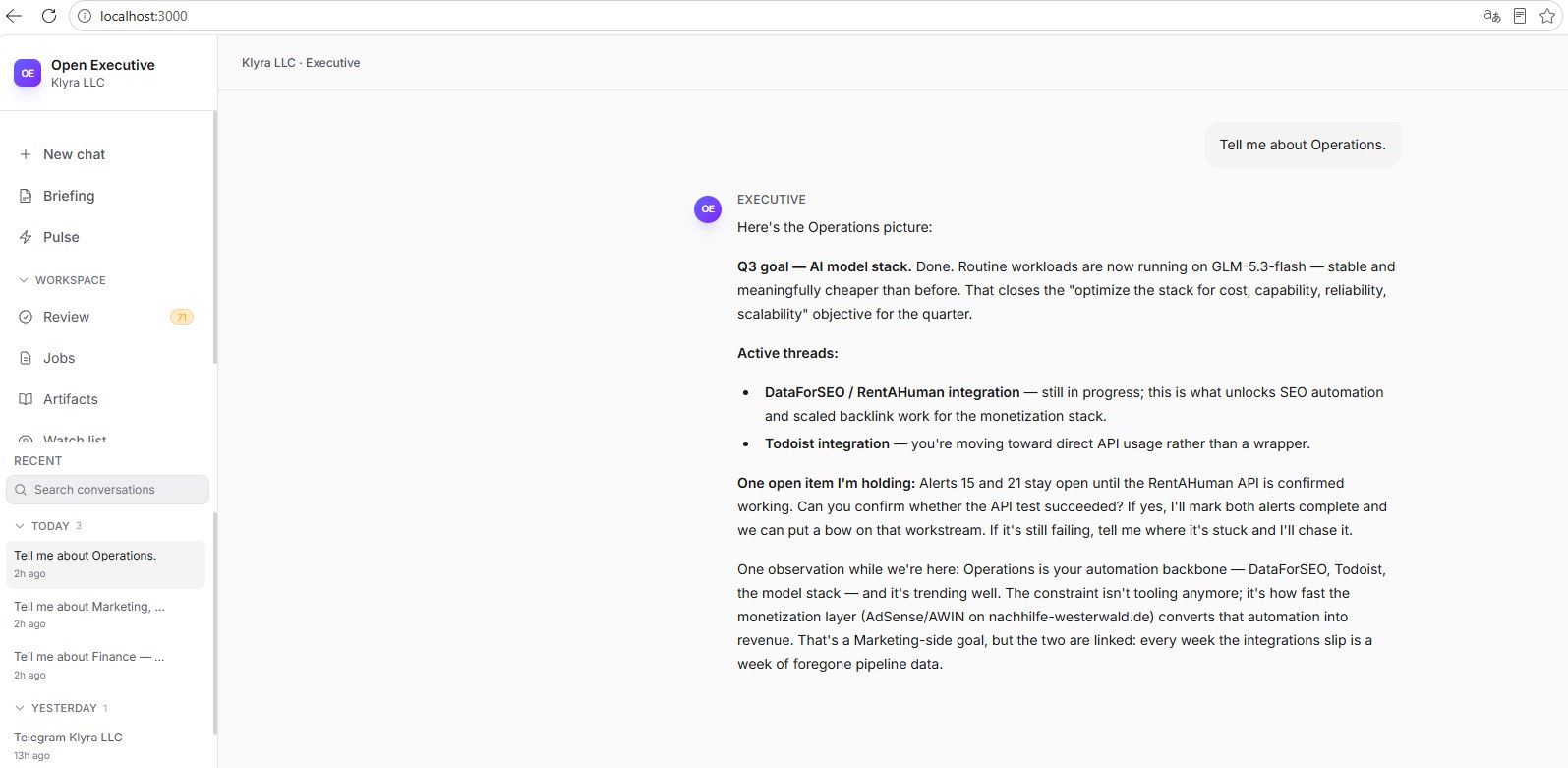
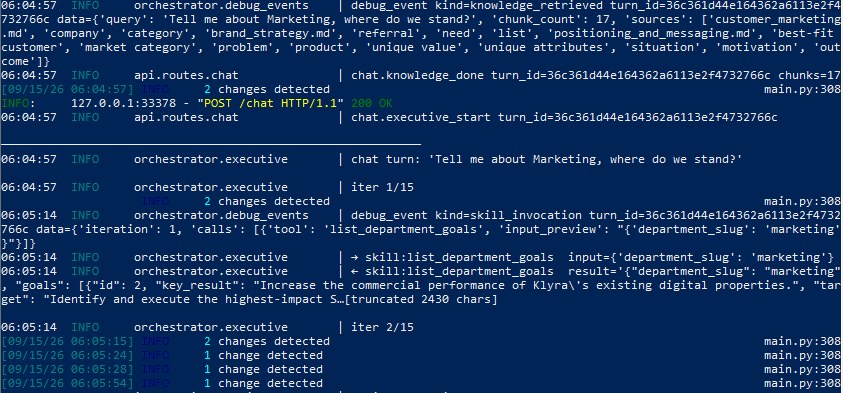
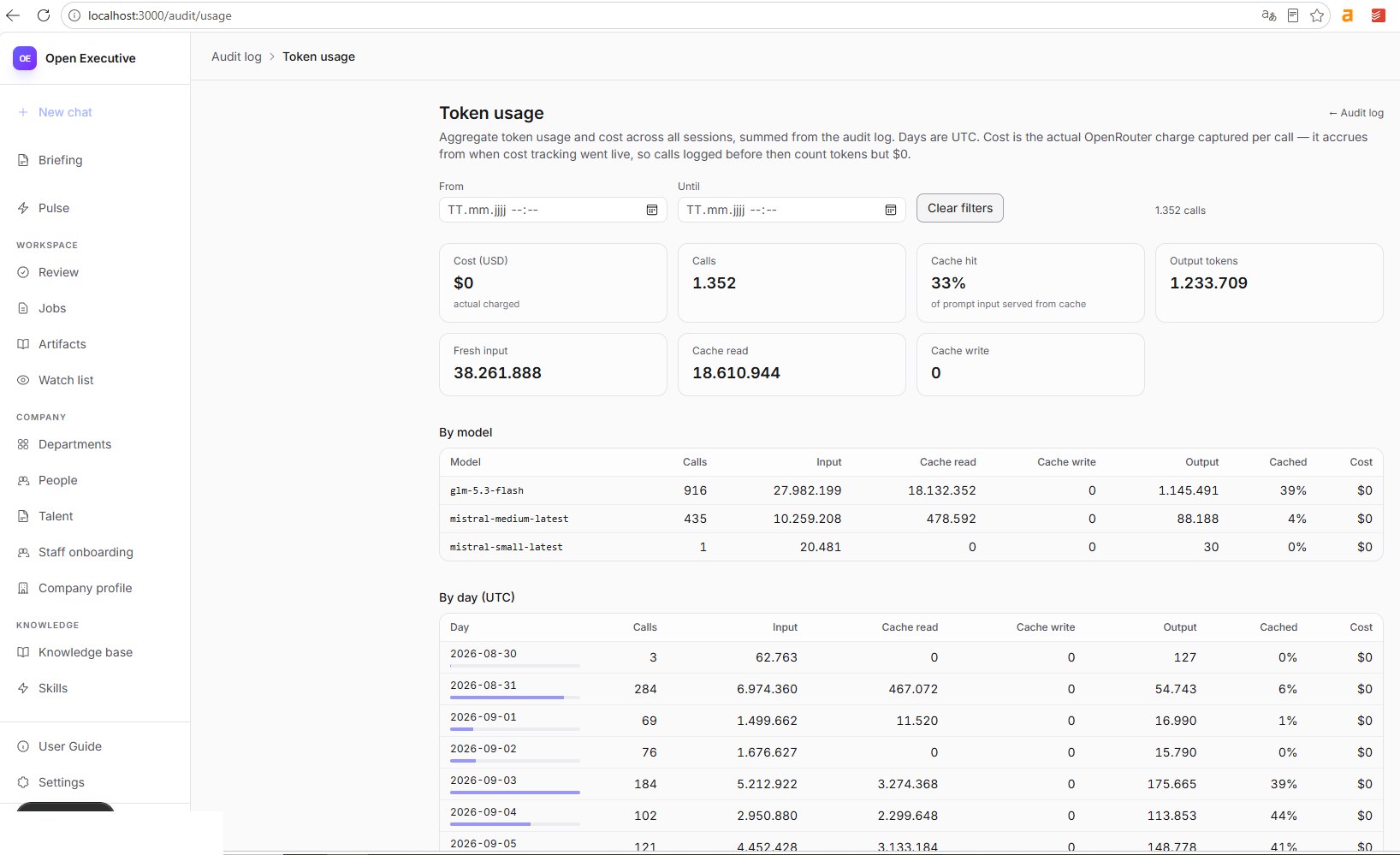
The screenshots above are practical evidence from one real configuration, not universal performance guarantees.
What Still Needs Improvement
OpenExecutive is promising, but it is not a finished replacement for human management. Several areas still require refinement.
Better filtering
The system's usefulness depends heavily on the quality of its filters and priorities. If too many low-value messages, notifications or recommendations are surfaced, the user may simply exchange one form of information overload for another. The goal should be selective attention — surface what requires action, suppress what does not, distinguish urgent from merely interesting, avoid repeating information unnecessarily, and escalate only when human judgment is needed. This is an ongoing optimization process.
More precise workflows
The system also benefits from precise instructions. The user must communicate which tasks belong to which department, which decisions require approval, which actions are allowed automatically, which sources are authoritative, which priorities take precedence and which situations require escalation. The more clearly these rules are defined, the more consistently the system can operate. This is not unique to OpenExecutive — it is a general principle of business automation: unclear processes produce unreliable automation.
Human oversight
OpenExecutive should not be treated as an unrestricted autonomous executive. Human oversight remains essential for financial commitments, legal matters, sensitive customer situations, employment decisions, public statements, irreversible technical actions and strategic decisions with significant consequences.
The most useful model is not "AI makes every decision." It is "AI prepares, coordinates and executes within clearly defined boundaries, while humans retain responsibility for important decisions." OpenExecutive does not eliminate the need for human involvement — it changes the nature of that involvement, from manually processing every piece of information to reviewing recommendations, approving consequential actions and correcting the system when its understanding is incomplete.
Why GLM-5.3-Flash Is Sufficient for This Setup
OpenExecutive can be used with different language models, and model selection will depend on the task, budget, speed requirements and desired quality. For the current KLYRA setup, GLM-5.3-Flash is used as the primary model.
The important observation is not that GLM-5.3-Flash is universally better than Claude, GPT or other models — that would be too broad a claim. The relevant point is that it is already capable of producing useful results within this particular workflow. For many operational tasks, the system does not need to produce a highly creative essay or solve an extremely difficult research problem. It needs to classify information, summarize messages, compare data, identify priorities, retrieve context, prepare responses, recommend next steps and coordinate tasks.
For these purposes, a fast and cost-efficient model may be more practical than using the most expensive available model for every interaction. Model quality still matters, especially for complex reasoning and sensitive decisions — but the overall value of OpenExecutive comes from the workflow surrounding the model, not from model branding alone.
Hosting, Performance and Cost
One of the notable aspects of the current setup is that it does not require a powerful dedicated server. The system runs with support from a small desktop computer, an Intel i5 processor, 16 GB of RAM, a virtual Linux environment and external model APIs. The language model itself is accessed through an API rather than being fully run locally, which keeps local hardware requirements significantly lower than they would be for hosting a large language model directly.
In practical use, response times have been good, with some delays naturally depending on the model API, external data sources and the number of tools involved in a task. This makes the setup accessible to small businesses that do not want to invest in expensive AI infrastructure.
At the current data volume and with GLM-5.3-Flash, the daily API cost is below one US dollar. This figure should not be interpreted as a universal operating-cost guarantee — costs will vary with model selection, request volume, prompt and context size, tool usage, scheduling and external API pricing. Nevertheless, the current result is encouraging: it suggests a small business can experiment with a coordinated AI operating layer without necessarily incurring the infrastructure or API costs associated with large-scale enterprise deployments. The key is to match the model and workflow to the actual task.
What OpenExecutive Is — and What It Is Not
OpenExecutive is
- An open-source AI operating layer
- A way to organize business work around shared context
- A framework for coordinating specialized AI functions
- A tool for analysis, prioritization and task continuity
- A potential bridge between business information and execution
- A practical foundation for customer service and marketing automation
OpenExecutive is not
- A guaranteed autonomous CEO
- A substitute for human responsibility
- A complete enterprise resource planning system
- A replacement for every specialist
- A system that works perfectly without configuration
- A reason to remove human approval from sensitive workflows
The distinction is important because the "AI CEO" label is attractive but misleading if interpreted literally. The more useful question is not whether AI can replace a CEO, but how much more capable one person can become with the right AI operating layer.
Who Could Benefit From OpenExecutive?
Small business owners
Owners who manage many functions themselves can benefit from a central system that maintains context and helps coordinate work.
Solo consultants
Consultants often need to switch between research, communication, project management, marketing and strategy. A shared operating layer can reduce fragmentation.
Small agencies
Agencies may use OpenExecutive to coordinate client information, internal tasks, marketing analysis and recurring operational workflows.
Technical entrepreneurs
People comfortable with self-hosting, APIs and automation may appreciate the ability to inspect and customize the system rather than relying entirely on a closed SaaS platform.
Businesses with repetitive information work
Organizations that regularly process emails, reports, research, customer requests or operational data may find the greatest immediate value in workflow automation. The system is less suitable for organizations expecting a fully autonomous executive that can safely make unrestricted decisions without supervision.
KLYRA's Assessment
From a practical perspective, OpenExecutive's strongest feature is not the novelty of its AI agents. It is the way it attempts to connect information, context, priorities and execution.
The system becomes particularly useful when the company context is well maintained, the workflows are clearly defined, the integrations provide current information, the user reviews and corrects recommendations, the system is used consistently rather than occasionally, and tasks are connected to actual business goals.
Its weaknesses are equally important: filters need continuous improvement, workflows require precise configuration, context must be kept accurate, some tasks still need human judgment, external actions require careful permission boundaries, and the system should not be treated as infallible.
The current KLYRA experience suggests that OpenExecutive is already useful as a practical business tool. It is not a finished autonomous management system, but it does not need to be one to provide value.
Conclusion
OpenExecutive is best understood as an AI operating layer for businesses that want more than isolated chatbot conversations or static reporting dashboards. Its central promise is continuity: a system that can retain business context, coordinate specialized functions, analyze current information and help keep work connected to strategic priorities.
The existing integrations with email, DataForSEO and SEO tools make the concept particularly interesting for customer service and marketing. Instead of merely displaying information, OpenExecutive can potentially connect incoming requests and live data to recommendations, responses, tasks and follow-up actions. That is where its competitive potential lies.
A dashboard tells you what changed. A monthly report summarizes what happened. An AI operating layer can help determine what deserves attention next and how the business should respond.
The system still requires configuration, oversight and responsible boundaries. But for a small business, the ability to operate with a coordinated AI system throughout the day may be more valuable than simply having access to another powerful chatbot.
The most compelling aspect is not that OpenExecutive behaves like a human executive. It is that one person can increasingly operate with the support of a coordinated AI system that works continuously, maintains context and helps keep the business focused. That is a more realistic — and potentially more useful — vision of the AI executive.
Exploring an AI operating layer for your own business?
KLYRA advises on practical AI setups, model selection and automation for small businesses — no enterprise budget required.
Start a conversation